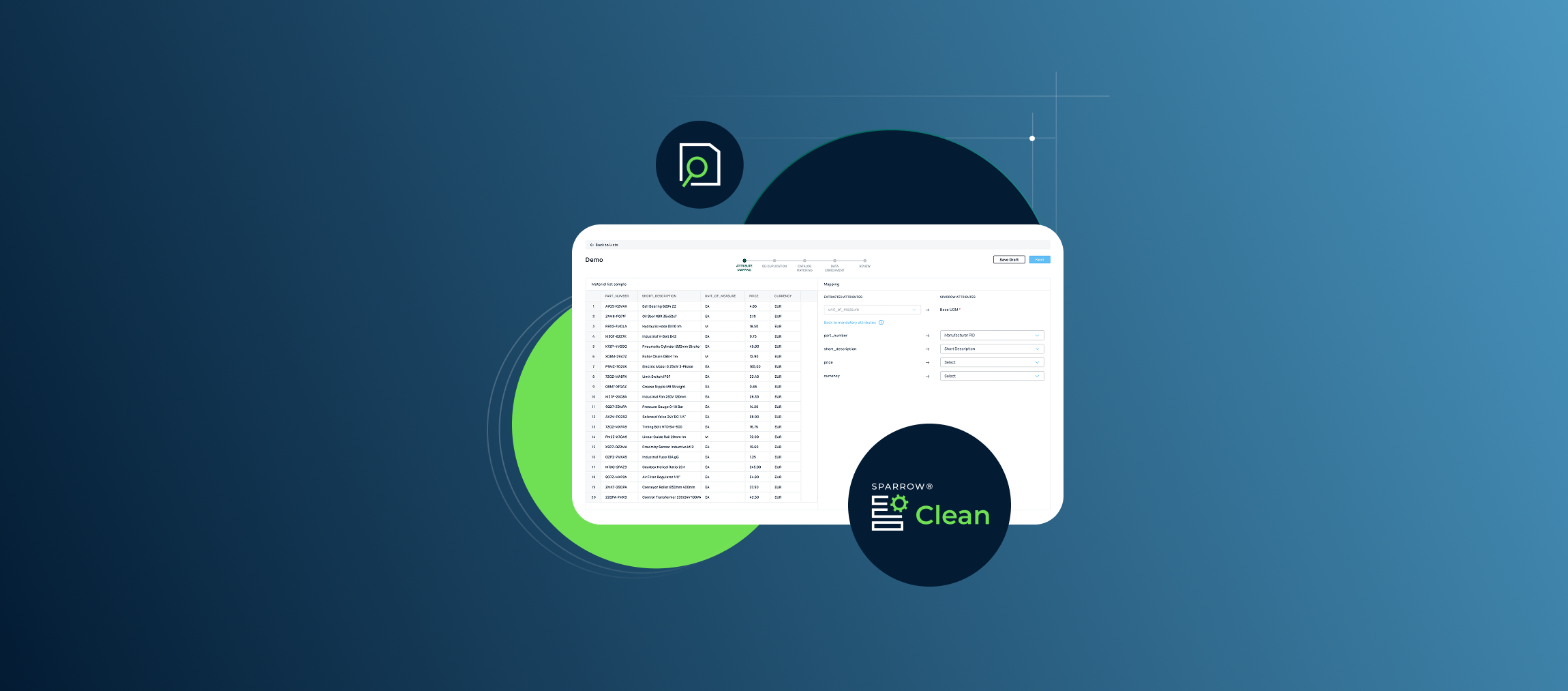
New in SPARROW.Clean: Create Spare Parts in Bulk via List Upload
Creating new spare parts is not a simple master data task. It is a structural challenge. As we have outlined before, errors rarely occur due to carelessness. They arise from incomplete information, inconsistent naming conventions, and limited visibility into whether a part already exists. SPARROW.Clean was built to solve this with clear processes, intelligent validation, and guided decision-making.
In practice, however, spare parts are not always created one at a time. When commissioning new machinery, launching projects or processing supplier quotations, material data typically arrives in bulk.
This is why we have introduced List Upload in SPARROW.Clean. You can now create spare parts at scale without compromising on data quality, transparency or control. Leonid Vogel, Head of Product at SPARROW explains:
“At its core, List Upload is simply single-part creation at scale: built on the same quality principles, but optimised for real industrial data volumes.”
Typical Use Cases
List Upload is designed for situations where material data is generated in larger volumes, for example:
- Commissioning: Spare parts lists for new machinery or production lines
- Engineering: Bills of Materials (BOMs) from projects or design data
- Procurement: Supplier lists from quotations, framework agreements or system migrations
Instead of manual entry or fragmented "offline" processes, these lists can now be processed directly within the SPARROW.Clean ecosystem.
How it Works: The SPARROW.Clean List Upload
The upload uses XLS, CSV and even PDF files and is fully integrated into the existing SPARROW.Clean workflow.
- Upload & Assign: Upload your file, assign it to a specific plant (Unit) and give it a unique name. The plant assignment follows the same logic as standard material creation.
- Attribute Mapping: Spare parts lists rarely follow a standard structure. Column headers, languages and formats vary. During upload, columns are mapped once to the SPARROW data model. Mandatory attributes are clearly highlighted.
- In-List Deduplication: If a list contains the same material multiple times (common in complex BOMs), SPARROW.Clean detects and merges them automatically. Each material is created only once.
- Catalog Matching: SPARROW.Clean checks your list against your existing material master. Potential matches are displayed transparently, allowing you to confirm or reject them to prevent duplicates before they happen.
- Data Enrichment: Where possible, materials are automatically enriched using SPARROW catalogues and external sources. This helps refine descriptions and complete missing attributes.
- Review & Approval: Before final creation, users receive a comprehensive overview: which parts will be created, which have been excluded, and where duplicates or inconsistencies were detected. Materials are only created after explicit approval.
The entire process is collaborative and flexible. Lists can be saved, paused, resumed or handed over to another team member at any stage.
Why This Matters
List Upload closes a critical gap in the material master lifecycle. It applies the same “clean at source” principles used for individual part creation to industrial-scale data volumes — without introducing workarounds or manual pre-processing.
For Maintenance, Engineering, and Master Data teams, this means:
- Significantly less manual rework.
- Zero duplicates from day one.
- A consistent onboarding process for new spare part inventories.
With this update, SPARROW.Clean isn’t just a tool for cleaning old data—it’s the definitive, controlled source for all new material master data, regardless of volume.